
Run a quick experiment. Recall the last meaningful mistake you made — and the first sentence your mind said about it. Now imagine a close friend made the identical mistake and came to you with it. Compare the two scripts.
For most adults the gap is enormous. The friend gets context, warmth, and perspective. You get a prosecutor. And most of us have a quiet justification ready: the harshness is necessary — it's what keeps standards up. It's the engine.
The research says otherwise, repeatedly. Self-criticism doesn't power performance; it powers anxiety, procrastination, and quitting. Self-compassion — the genuine article, not the greeting-card version — turns out to be the more effective engine and the more pleasant place to live. Here's what it actually is, and five exercises that train it.
What Self-Compassion Actually Is
Researcher Kristin Neff, whose work defines the field, describes self-compassion as three components working together:
Self-kindness — responding to your own failure and pain the way you'd respond to someone you love: with warmth rather than verdicts.
Common humanity — locating your struggle inside the shared human condition (everyone fails; this is what being a person includes) instead of inside your defectiveness (everyone else manages; what's wrong with me?). This component is the quiet antidote to shame, which always insists you're the only one.
Mindfulness — seeing the pain accurately: neither suppressing it ("I'm fine") nor drowning in it ("I always ruin everything"). You can't respond kindly to something you won't look at — which is why the noticing skill underwrites this whole area.
Two boundary lines, because the misunderstandings kill the practice. Self-compassion is not self-esteem — self-esteem needs you to evaluate yourself highly (and wobbles every time evidence dips); self-compassion needs no verdict at all, which makes it stable precisely when you fail. And it is not self-pity or letting yourself off — studies consistently associate self-compassion with more accountability and persistence, not less, because people who aren't braced against shame can afford to look at their mistakes squarely.
The Performance Paradox
Worth stating plainly, because the inner critic will object: kinder is more effective, not less. The mechanism is simple once seen. Self-criticism is a threat — and your nervous system responds to internal threats exactly as it does to external ones: cortisol, narrowed attention, avoidance. A self-critical mind learns that mistakes equal attack, so it starts avoiding situations where mistakes are possible — which is to say, anything worth doing. Self-compassion removes the attack, which removes the avoidance. People high in self-compassion try again sooner, take more responsibility, and procrastinate less. The prosecutor was never the engine. He was the handbrake.
The Inner-Critic Audit (Do This Once)
Before the exercises, ten minutes of reconnaissance. Write down, verbatim, what your inner critic actually says — the real phrases, in its real tone. Then three questions: Whose voice is this, originally? (It's rarely yours.) Would I say this sentence, in this tone, to anyone I love? What is it afraid would happen if it went quiet?
That last one deserves respect rather than war: most inner critics believe they're protecting you — from complacency, from humiliation. The work isn't to destroy the critic but to retire it from a job it was never good at.
Five Exercises
1. The friend letter. Take something you're currently harsh with yourself about. Write a letter to yourself about it from the perspective of an unconditionally loving friend who knows everything — the context, the pressures, the history. Don't perform; write what that friend would honestly say. This is the most-studied exercise in the field, and its power is that you already possess the compassionate voice — you use it on others daily. The letter just redirects existing skill.
2. The hand-on-chest reset (20 seconds). In a hard moment: place a hand flat on your chest or anywhere comforting, feel the warmth and pressure, take one slow breath. That's all. Soothing touch activates the same care-circuitry regardless of who the hand belongs to — it's co-regulation, self-administered. Pair it silently with one phrase from exercise four if words help.
3. The common-humanity reframe. When shame says only you, deliberately complete this sentence: "Right now, thousands of other people are also feeling ___ because they also ___." Not to minimise your situation — to relocate it. Shame is a story about exile; common humanity is the documented fact that the colony of people who've made your exact mistake is enormous and includes several people you admire.
4. The self-compassion break (60 seconds). Neff's portable classic — three sentences, said internally, in order: "This is a moment of struggle." (mindfulness) "Struggle is part of being human." (common humanity) "May I be kind to myself right now." (self-kindness — adjust the wording until it doesn't make you cringe; "steady on, mate" is a legitimate translation). Sixty seconds, available everywhere, improves with repetition like everything else.
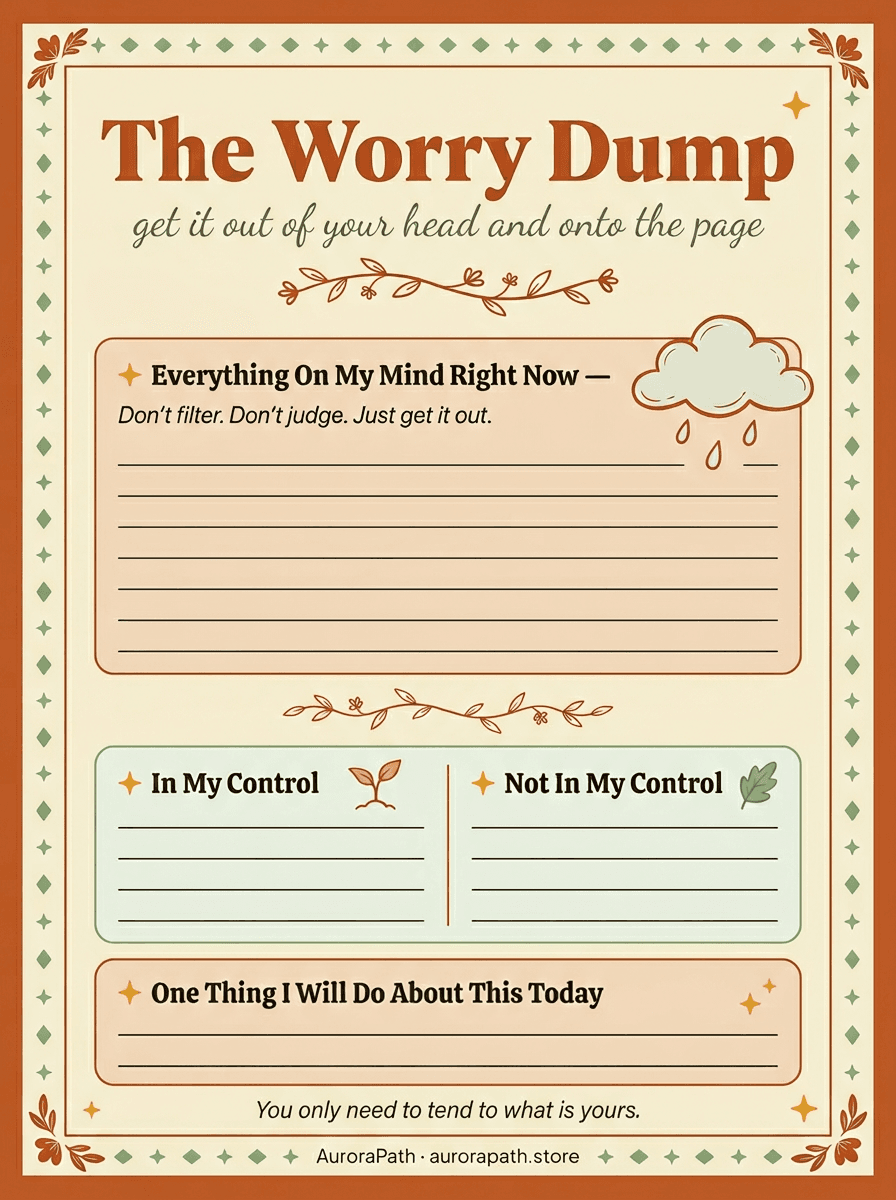
5. The end-of-day amnesty. Last thing before sleep, name the day's failure your mind is preparing to chew on, and formally close it: "That happened. I was doing my best with what I had. Court's closed until morning." If it needs action, write the one-line action down for tomorrow. This pairs beautifully with a worry-offload and starves the 2am rumination loop of its favourite material.
If This Feels Fake at First
It will — that's normal and well-documented. The compassionate phrases feel foreign, even threatening, to people with decades of critic mileage; researchers call the initial discomfort "backdraft," and it fades with practice. Treat it like a new language: clumsy for weeks, then suddenly you catch yourself saying well, that was hard, no wonder you're tired — fluently, without deciding to. That's the skill arriving.
One more reason to bother, for the parents reading: children calibrate their inner voice on the one they hear you use about yourself. Self-compassion, practised audibly — "I made a mistake, I'm going to try again" — is one of the most heritable gifts in this whole field. (We wrote the children's side of it in teaching children self-compassion.)
author: "AuroraPath"
Phase two of Find Your Ground — AuroraPath's 30-day mindfulness journal for adults — is where this work lives: honest reflection, values, and the slow replacement of the prosecutor with something wiser. Our free collection of 10 mindfulness worksheets is an instant download at aurorapath.store.
From the AuroraPath Store
Find Your Ground
A 30-day mindfulness challenge. 90 beautifully designed pages — instant download.
$19.99
Get Find Your Ground →Instant PDF download · Print at home
AuroraPath
Creator of AuroraPath
Alex Ewing created AuroraPath to make premium mindfulness resources accessible for every family. Grow Calm is the first book in the AuroraPath collection.