
Mindfulness and anxiety have a complicated relationship.
On one hand the research is genuinely compelling. Mindfulness-based interventions consistently reduce anxiety symptoms across dozens of well-designed studies. Mindfulness-Based Stress Reduction — an eight-week programme developed by Jon Kabat-Zinn — has been shown to reduce anxiety, depression, and chronic pain with effect sizes that compare favourably to medication for mild to moderate presentations.
On the other hand many anxious people try mindfulness and find it makes things worse. They sit with their breath and their anxiety amplifies. They try to be present and discover that the present moment is exactly where the anxiety lives. They feel like failures at the one thing that is supposed to help them.
This apparent contradiction is not actually a contradiction. It is the result of a widespread misunderstanding about what mindfulness is for and how it works with anxiety specifically.
The Most Important Thing to Understand About Mindfulness and Anxiety
Mindfulness does not work for anxiety by making you calm.
That sounds counterintuitive so let me say it again. The goal of mindfulness practice for anxiety is not to feel calm. It is to change your relationship with the anxiety you feel.
The traditional approach to anxiety — which most of us have absorbed without realising it — is to treat anxiety as a problem to be solved. We try to push it away, argue with it, distract ourselves from it, or fix the conditions that are causing it. When those strategies fail we feel worse — because now we have the original anxiety plus the anxiety about having anxiety.
Mindfulness offers a completely different orientation. Instead of treating anxiety as something that needs to be eliminated — it treats anxiety as an experience to be observed. You notice it. You name it. You allow it to be there without either fighting it or being swept away by it. And paradoxically — consistently, reliably — this orientation reduces anxiety's power over you more effectively than fighting it ever does.
This is sometimes called the acceptance paradox. The more completely you can accept the presence of anxiety — not welcome it, not enjoy it, not want it to stay, just allow it to be there — the less it escalates.
Why Mindfulness Sometimes Makes Anxiety Worse
Understanding when and why mindfulness amplifies anxiety rather than reducing it is important — because if you have had this experience you may have concluded that mindfulness simply does not work for you. It almost certainly does. But the approach needs adjusting.
Sitting still with anxiety can be destabilising. Traditional seated breath meditation asks you to sit with whatever arises. For someone whose anxiety is mild to moderate this is manageable and therapeutic. For someone in the middle of significant anxiety — particularly anxiety that has a physical dimension like panic — sitting still and turning attention inward can intensify the experience. This is not failure. It is a signal that you need a different entry point.
Breath focus can trigger anxiety in some people. Some people — particularly those with a history of panic disorder or health anxiety — find that focusing attention on the breath increases anxiety rather than reducing it. The breath becomes something to monitor and worry about rather than a neutral anchor. If this is your experience switch to an external anchor — sounds in the environment, the sensation of your feet on the floor, the temperature of your hands. Mindfulness does not require breath focus.
Mindfulness without self-compassion backfires. Using mindfulness to observe yourself anxiously and then criticising yourself for being anxious is not mindfulness — it is a new form of the same self-attacking pattern that drives much anxiety. Genuine mindfulness practice always includes an element of self-compassion. You notice the anxiety. You acknowledge it is there. You treat yourself with the same kindness you would offer a friend in the same situation.
Techniques That Actually Help
The RAIN technique. RAIN is an acronym developed by mindfulness teacher Tara Brach that provides a simple and powerful framework for working with anxiety in the moment.
R — Recognise. Notice that anxiety is present. Name it. There is anxiety here.
A — Allow. Resist the urge to push it away or fix it. Allow it to be there. This is here and I am not going to fight it right now.
I — Investigate. Get curious about the physical experience of the anxiety. Where is it in your body? What does it feel like — tight, buzzing, heavy, sharp? What thoughts are accompanying it? You are moving from being inside the anxiety to observing it — which creates a crucial psychological distance.
N — Nurture. Offer yourself some compassion. What would you say to a friend who was feeling this way? Say that to yourself. Place a hand on your chest if that helps.
The RAIN technique does not make anxiety disappear. It changes your relationship with it from one of combat to one of curious, compassionate observation. Over time this is profoundly regulating.
Grounding techniques for acute anxiety. When anxiety is acute — when it is loud and physical and hard to observe from a distance — grounding is more useful than meditation. Grounding techniques redirect attention to the present physical environment rather than the anxious internal narrative.
The 5-4-3-2-1 technique: name five things you can see, four you can physically touch, three you can hear, two you can smell, one you can taste. This is not distraction — it is a deliberate engagement of sensory present-moment awareness that interrupts the anxiety loop by engaging the prefrontal cortex.
Cold water on the wrists. The physical sensation of your feet flat on the floor. Holding something with a distinctive texture. These sensory anchors work because they are direct — they give the anxious nervous system something immediate and concrete to attend to.
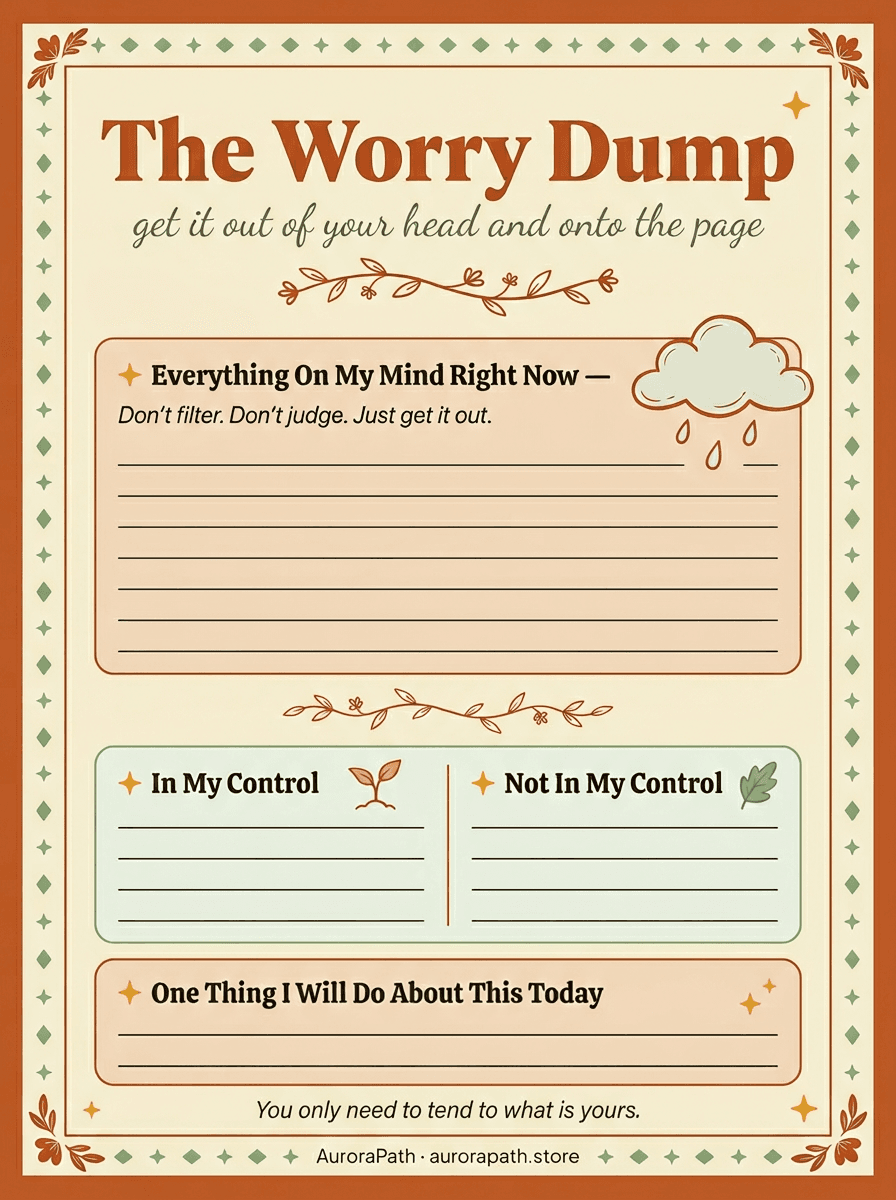
The worry window. Designate a specific fifteen-minute window each day as your official worry time. When anxious thoughts arise outside of that window — acknowledge them and postpone them. Yes, I hear you. We will think about this at 5pm. Then at 5pm actually sit with the worries deliberately for fifteen minutes.
This technique works because it does two things simultaneously. It prevents anxiety from colonising the whole day by giving it a bounded time and place. And it demonstrates to your nervous system that the worries are not being ignored — they are being scheduled. This reduces the urgency that makes anxiety feel so relentless.
The physiological sigh. This is a breathing technique that produces faster anxiety relief than most other approaches. A double inhale through the nose — breathe in fully, then take a second short sniff to maximally inflate the lungs — followed by a long slow exhale through the mouth.
This specific breath pattern deflates the alveoli in the lungs more completely than a normal exhale, which produces an immediate activation of the parasympathetic nervous system. It is the fastest breathing-based intervention for acute anxiety currently supported by research.
Building a Sustainable Practice
The research consistently shows that the benefits of mindfulness for anxiety are dose-dependent and cumulative. Ten minutes a day for two months produces significantly better outcomes than occasional practice during crisis moments.
This does not mean you need to meditate for an hour. Ten minutes is enough. Consistent daily practice — even imperfect, even reluctant — builds the neural pathways that make the tools available when you need them most.
The most important thing is finding an entry point that works for you specifically. If seated breath meditation makes your anxiety worse — use grounding. If formal practice feels too demanding — start with one deliberate breath before a difficult situation. If silence is intolerable — use a guided meditation app.
Mindfulness is not one thing. It is a broad set of practices unified by the intention to bring present-moment awareness to experience with curiosity and without judgement. Within that broad definition there is space for an approach that works for you.
Start there. Build from there.
Related reading: nervous system regulation exercises and mindfulness for beginners.
If you want a gentle, structured entry point, Find Your Ground — AuroraPath's 30-day mindfulness journal for adults — builds grounding and breathwork into a daily practice from day one. Our free collection of 10 mindfulness worksheets, including anxiety management tools and breathing techniques, is also available as an instant free download at aurorapath.store.
From the AuroraPath Store
Find Your Ground
A 30-day mindfulness challenge. 90 beautifully designed pages — instant download.
$19.99
Get Find Your Ground →Instant PDF download · Print at home
AuroraPath
Creator of AuroraPath
Alex Ewing created AuroraPath to make premium mindfulness resources accessible for every family. Grow Calm is the first book in the AuroraPath collection.