
Most beginner mindfulness guides fail their readers in the first paragraph — by promising bliss, demanding stillness, or describing a serene experience that bears no resemblance to what actually happens when a normal person closes their eyes for the first time (a to-do list, an itch, and the chorus of a song from 2009).
This guide takes the other approach: an honest description of what mindfulness is, why most beginners quit, and a first week that assumes you are busy, sceptical, and in possession of a completely ordinary noisy mind.
What Mindfulness Actually Is
Mindfulness is noticing what's happening while it's happening — in your body, your mind, your surroundings — with a bit less judgement and a bit more curiosity than usual.
That's it. It is a trainable attention skill, not a belief system, a personality type, or a feeling of calm. Calm is a frequent side effect; it is not the assignment. Some of the most useful mindful moments are entirely uncalm — noticing I'm furious right now while it's happening, rather than discovering it later from the wreckage.
The training mechanism is almost embarrassingly simple: you rest attention on an anchor (the breath, sounds, the body), attention wanders off, you notice it wandered, you bring it back. The wandering is not failure — the noticing-and-returning is the repetition. Every return is one rep. A "bad" session with forty wanders is forty reps.
The Four Myths That Make Beginners Quit
Myth 1: "I'm supposed to empty my mind." Nobody can do this. Minds produce thoughts the way hearts produce beats — research suggests we spend nearly half our waking hours mind-wandering. The practice is noticing thoughts, not eliminating them. Beginners who think they're failing at thought-stopping are usually practising perfectly.
Myth 2: "I'm too distractible — my brain is too busy for this." Backwards. Distractible minds get more reps per session. Telling a busy-brained person they can't do mindfulness is telling an unfit person they can't do exercise — the unfitness is the reason, not the disqualification.
Myth 3: "It should feel good." Sometimes it does. Sometimes it's boring, itchy, or briefly uncomfortable as you notice things you've been outrunning. The benefits — measurably lower stress reactivity, better attention — come from the practice, not from in-session pleasantness, and they arrive over weeks. (The brain research on what eight weeks of practice changes is worth a read for the honest dose-response picture.)
Myth 4: "Real practice means 30 silent minutes on a cushion." The research mostly used 10–20 minutes; benefits track consistency, not heroics. Five minutes daily beats forty minutes on alternate Sundays — and if sitting itself is the obstacle, there is a whole legitimate path that never uses a cushion.
Your First Week — the Realistic Plan
Days 1–7, one rule: five minutes, once a day, same time-ish. Anchor it to something that already happens — after the kettle goes on, after the school run, before lunch.
The five minutes themselves:
- Sit anywhere ordinary. Chair is fine. Eyes closed or soft-focused on the floor.
- Take one slow breath with a long exhale, just to arrive.
- Rest attention on the feeling of breathing — nostrils, chest, or belly, wherever it's most obvious. You're not controlling the breath, just feeling it.
- When you notice you've drifted into thought — and you will, within seconds — silently note "thinking," without the editorial ("ugh, typical"), and return to the breath.
- Repeat until the timer goes. That's the whole thing.
Expected experience, so you can't be ambushed: days 1–2 feel novel, days 3–5 feel boring and pointless (this is the quitting window — it's also exactly when the reps are accumulating), and somewhere around days 6–10 most people get their first unprompted noticing out in real life — catching irritation mid-rise, or actually tasting lunch. That moment is the skill escaping the laboratory. It's small, and it's the beginning of everything.
Choosing Your Doorway
Breath-watching is the default doorway, not the mandatory one. If it doesn't fit, pick by how your brain runs:
- Restless body? Movement-anchored practice — mindful walking is a complete practice, not a consolation prize.
- Anxious, and breath-focus makes it worse? This is real and common. Use external anchors instead: sounds, or the 5-4-3-2-1 senses sweep. Grounding is mindfulness with the stabilisers on — see our anxiety-specific guide.
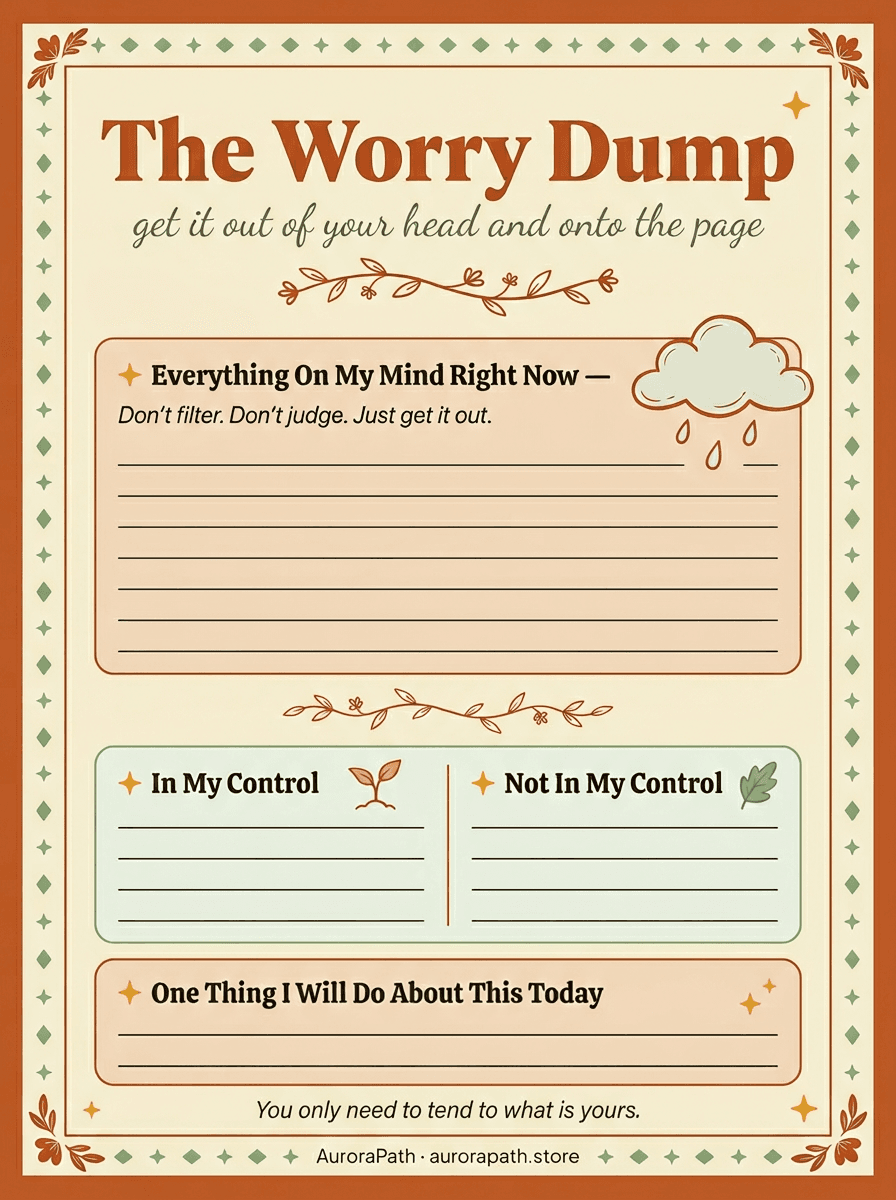
- Verbal, reflective brain? Journaling-based practice — a daily page against an honest prompt trains the same noticing. (Thirty prompts here.)
- Need everything structured or it won't happen? A guided programme with a daily page that tells you exactly what today's practice is. That's the gap Find Your Ground — our 30-day mindfulness journal for adults — was built to fill: each day pairs a short practice with a reflection, so the only decision you make is showing up.
After Week One
If the five minutes mostly happened: keep going exactly as-is for three more weeks before changing anything. The honest habit research says automaticity takes weeks-to-months, and the single best predictor is not breaking the chain in the early days — though missing one day, reassuringly, does no measurable damage.
If the five minutes mostly didn't happen: shrink it. Two minutes. One breath at the front door. The version that happens is the right version — you can grow a real practice from one deliberate breath a day, and no one ever grew one from an abandoned app subscription.
author: "AuroraPath"
Find Your Ground — AuroraPath's 30-day mindfulness journal for adults — is the structured on-ramp version of everything above: 90 printable pages, fifteen minutes a day, no experience needed. And our free collection of 10 mindfulness worksheets is an instant download at aurorapath.store.
From the AuroraPath Store
Find Your Ground
A 30-day mindfulness challenge. 90 beautifully designed pages — instant download.
$19.99
Get Find Your Ground →Instant PDF download · Print at home
AuroraPath
Creator of AuroraPath
Alex Ewing created AuroraPath to make premium mindfulness resources accessible for every family. Grow Calm is the first book in the AuroraPath collection.