
The moment you lie down to sleep your brain decides it is an excellent time to process everything you have been too busy to think about all day.
The conversation you had at work. The thing you forgot to do. The worry that has been circling at the edge of your awareness since Tuesday. The vague sense that something important is wrong that you cannot quite name. All of it surfaces the moment the external stimulation stops and the room goes quiet.
This is not a malfunction. It is the brain doing exactly what it is designed to do — processing the experiences of the day, consolidating memories, running threat assessments. The problem is not that this happens. The problem is that it happens at the exact moment your body needs to be moving toward sleep rather than staying alert.
Mindfulness helps with sleep not by turning the brain off — that is not something mindfulness can do and not something it is trying to do — but by changing your relationship with the thoughts and worries that arrive at night, so that they no longer have the power to keep you awake that they currently do.
Why an Overactive Mind Keeps You Awake
Sleep requires a particular physiological state — low cortisol, low core body temperature, slow brain wave activity. The stress response — which is activated by worry, rumination, and threat-focused thinking — produces the opposite of all of these.
When you lie in bed thinking about something worrying the brain does not distinguish between a thought about a threat and an actual threat. It responds the same way — cortisol rises, alertness increases, the body prepares for action. This is precisely the wrong preparation for sleep.
The more you try to stop thinking — the more you fight the thoughts, tell yourself to stop, become frustrated with your inability to switch off — the more activated the stress response becomes. You are not just worried about the original thing now. You are worried about the fact that you cannot stop worrying about it. The meta-anxiety about not sleeping often becomes more disruptive than whatever you were originally anxious about.
Mindfulness interrupts this cycle not by emptying the mind but by changing how you relate to what arrives in it.
The Core Mindfulness Shift for Sleep
The most important shift mindfulness offers for sleep is from fighting thoughts to allowing them.
When a thought arrives — a worry, a to-do item, a replaying of the day — the default response is to either follow it (engage with it, plan around it, solve it) or to fight it (try to suppress it, tell yourself to stop thinking it). Both responses activate the nervous system and make sleep harder.
The mindfulness response is different. Notice the thought. Name it — there is the work worry, there is the planning mind, there is the replay of that conversation. And then — without following it and without fighting it — return attention to the body. The weight of the body in the bed. The rise and fall of the chest. The sensation of warmth under the covers.
You are not trying to stop the thoughts. You are choosing not to board the train they are pulling into the station. You watch it arrive, you notice it, and you let it pass through without getting on.
This sounds simple. It is genuinely difficult at first. With practice it becomes one of the most reliable sleep tools available — not because it always works immediately but because it interrupts the escalation cycle that turns a mind that will not stop into a night of genuine insomnia.
Practical Techniques for a Mindful Pre-Sleep Routine
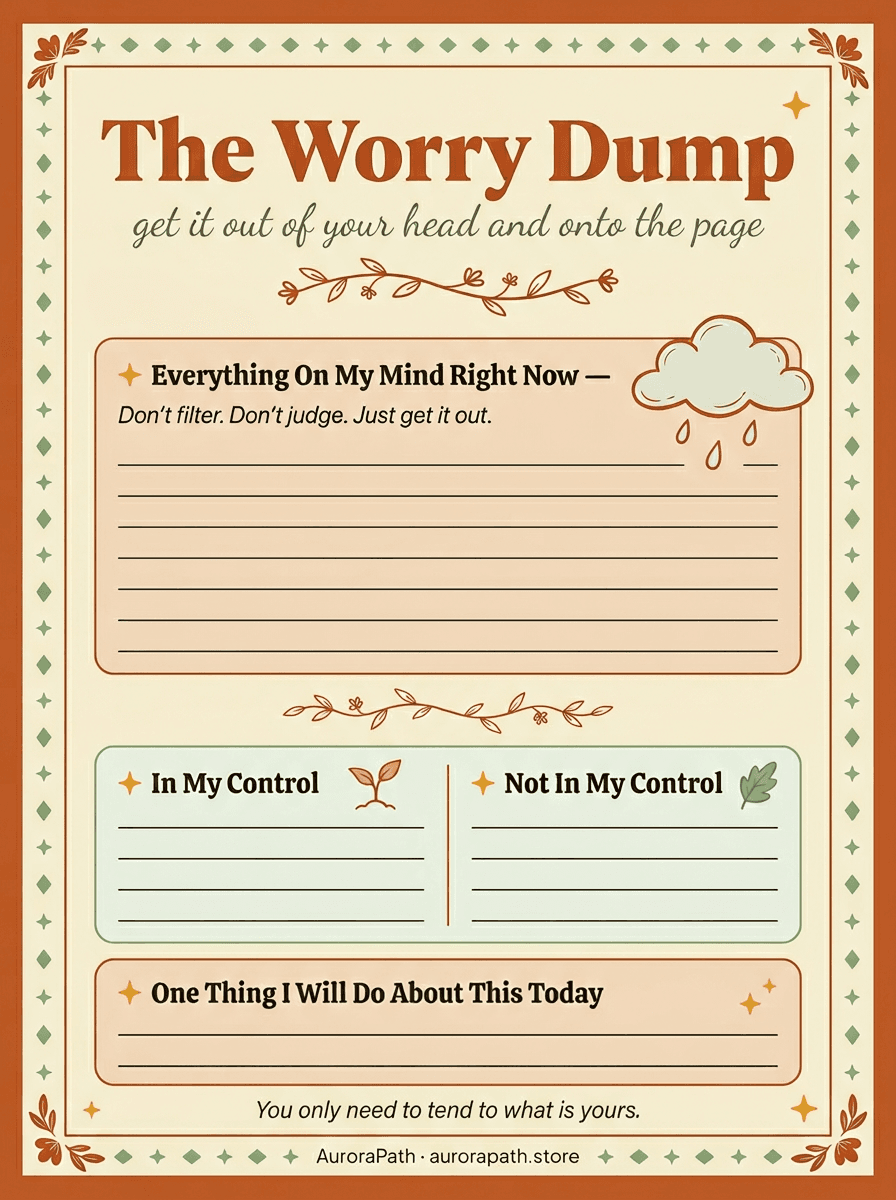
The worry offload — thirty minutes before bed. Keep a notebook by your bed. Thirty minutes before you intend to sleep — not in bed, at a desk or at the kitchen table — write down everything that is on your mind. Worries, to-do items, unresolved things, vague anxieties you cannot quite name. Get everything out of your head and onto paper.
This is not problem-solving. Do not try to resolve anything on the list. Just write it down. The act of externalising these items reduces the brain's need to keep them active in working memory — which reduces the mental noise that makes falling asleep difficult.
The body scan for sleep. Lie on your back. Starting at the top of your head and moving slowly down to the tips of your toes — bring your attention to each part of your body in sequence. You are not looking for anything. You are just noticing. Tightness or ease. Warmth or coolness. Heaviness or lightness.
When your attention wanders — to thoughts, to worries, to planning — notice it has wandered and gently return it to wherever you were in the body. Without frustration. Without self-criticism. Wandering and returning is the practice. It is not a mistake.
The body scan works for sleep because it moves attention from the cognitive mind — where the worrying happens — to the physical body — which is already in the bed, already still, already in the right position for sleep. You are not trying to fall asleep. You are just being in your body. Sleep often follows on its own.
The 4-7-8 breath. Breathe in for four counts through the nose. Hold for seven counts. Breathe out for eight counts through the mouth. Repeat four times.
This specific pattern produces a strong parasympathetic response — the physiological opposite of the stress response. The long hold and extended exhale directly reduce heart rate and cortisol. Many people find themselves asleep before completing four rounds.
Cognitive shuffling. This is a technique developed by sleep researcher Luc Beaulieu-Prévost based on research into how the brain transitions into sleep. Pick a random neutral word — something with no emotional charge, like apple or lamp or garden. Visualise it for a few seconds. Then move to the next image it randomly triggers — maybe a tree, then a bird, then a hat. The images should be random and unconnected.
The technique works by mimicking the naturally random imagery that precedes sleep onset — gently guiding the brain into the associative, non-linear thinking pattern that characterises the transition from wakefulness to sleep. It is particularly effective for people whose minds are highly verbal and conceptual — who lie awake in sentences rather than images.
What to Do When You Cannot Sleep
At some point you will lie awake for longer than feels manageable. The techniques are not working. The mind is loud. The body is alert.
Do not lie there fighting it.
Get up. Go to another room. Do something quiet and low-stimulation — read something undemanding, do a gentle stretch, make a warm drink. Stay away from screens and bright light. After twenty to thirty minutes return to bed.
This sounds counterproductive. It is not. Lying awake in bed for extended periods trains the brain to associate the bed with wakefulness and frustration rather than with sleep. Getting up and returning when you are genuinely sleepy reinforces the bed as a sleep space rather than an anxiety space.
Combined with a consistent sleep and wake time — the most evidence-supported intervention for chronic sleep difficulty — this approach rebuilds the relationship with sleep over time.
A Note on Chronic Insomnia
Mindfulness is genuinely effective for sleep difficulty caused by stress, anxiety, and an overactive mind. If you have been experiencing significant sleep disruption for more than a few weeks please speak to your GP or consider working with a therapist trained in Cognitive Behavioural Therapy for Insomnia — currently the gold standard treatment for chronic insomnia and significantly more effective long-term than sleep medication.
Mindfulness works beautifully alongside CBT-I. It is not a substitute for professional support when sleep disruption is severe.
Related reading: the digital sunset evening routine and the body scan guide.
Evening practice is one of the three daily anchors in Find Your Ground, AuroraPath's 30-day mindfulness journal for adults — a structured way to build the wind-down habit this article describes. Our free collection of 10 mindfulness worksheets, including evening wind-down tools, is also available as an instant free download at aurorapath.store.
From the AuroraPath Store
Find Your Ground
A 30-day mindfulness challenge. 90 beautifully designed pages — instant download.
$19.99
Get Find Your Ground →Instant PDF download · Print at home
AuroraPath
Creator of AuroraPath
Alex Ewing created AuroraPath to make premium mindfulness resources accessible for every family. Grow Calm is the first book in the AuroraPath collection.