You know the scene because you were in it last night: in bed, lights off, "just checking one thing." Forty minutes later you're deep in a stranger's argument, a news spiral, or video number eleven, wide awake at the exact hour you were desperate to be asleep at by 10pm this morning.
This article is not going to tell you screens are evil or that you should read Tolstoy by candlelight. You're an adult who lives online; the goal is a wind-down that works for someone like you — built on replacement rather than willpower, with one structural move doing most of the work.
What Late Scrolling Actually Does
Three separate mechanisms, stacking:
Arousal, more than light. Blue light gets the headlines (and it does nudge melatonin), but the bigger problem is content arousal. Feeds are engineered to provoke — outrage, novelty, social comparison, one-more-loop unfinishedness — and a provoked brain is an awake brain. You can night-shift your screen amber and still lie there activated, because the problem was never mainly the photons.
Sleep-pressure squandering. By late evening you're carrying a day's accumulated drowsiness — sleep pressure — that wants spending. Scrolling is stimulating enough to mask it: you override the drowsy window, get a "second wind," and pay with a later, shallower sleep onset. Miss the window often enough and you forget the window exists.
The time-blindness machine. Feeds are deliberately bottomless — no chapter ends, no credits roll. "Five minutes" becoming forty isn't weak character; it's the product working as designed. Which is why the fix below is architectural rather than motivational: you cannot out-discipline a casino, but you can decline to sleep inside one.
The 60/30/10 Architecture
A wind-down with three zones, counting back from your intended lights-out:
T-minus 60: the digital sunset. Feeds, news, and anything with a scroll go off — not all screens, just the bottomless ones. Bounded screen content (an episode with an end, a film) is honestly fine here for most people; the line is finite vs infinite. This is also the moment the phone leaves the bedroom (see below). If a genuine obligation keeps you reachable, keep calls audible and the rest dark.
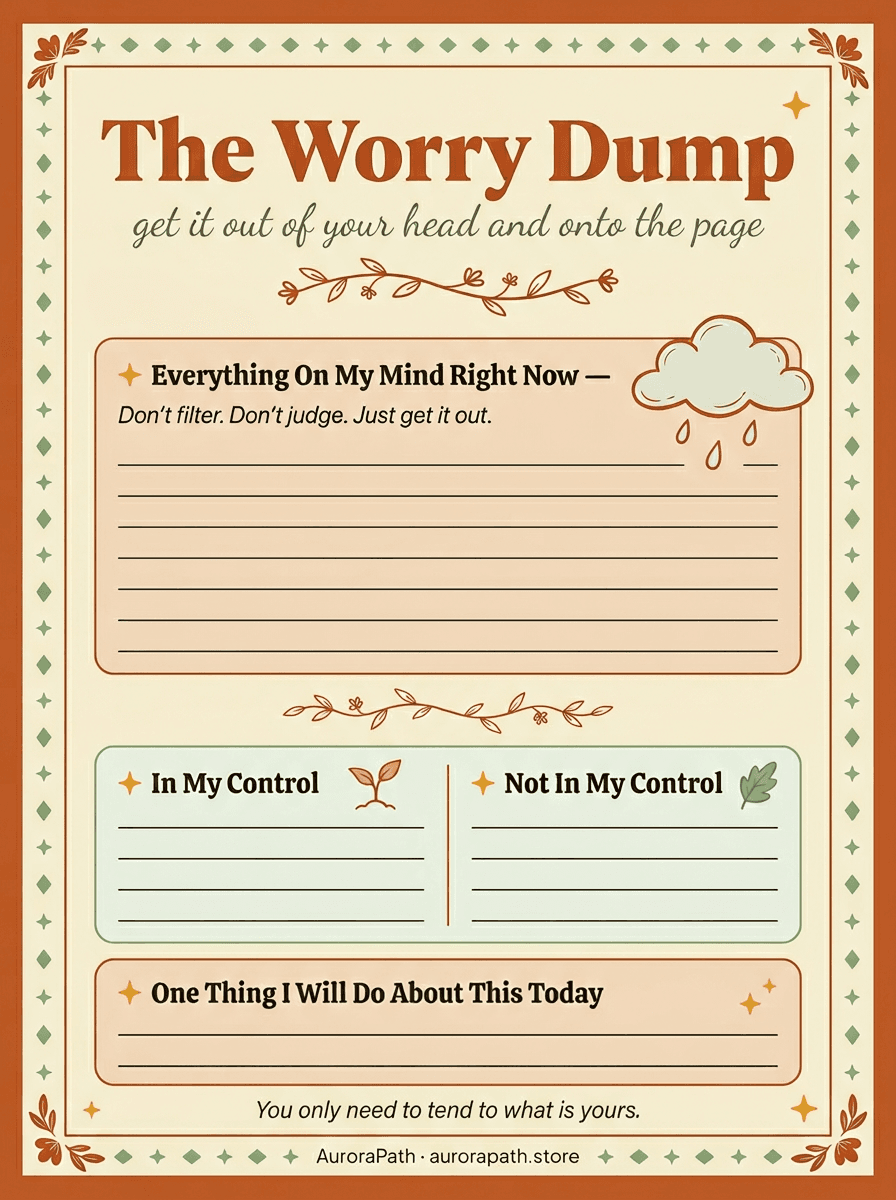
T-minus 30: the offload. Ten minutes with paper: tomorrow's first move written down, the open worries dumped into one list. This drains the mental tabs that would otherwise reopen at 1am — the same externalising move that quiets every other loop. Then low-stimulation analogue anything: shower, stretching, tidying (oddly settling), an actual book, dull is the point.
T-minus 10: the down-regulation. Lights low, in or near bed: a few rounds of long-exhale breathing or 4-7-8, or a body scan that you fully intend to fall asleep during. You're pairing the bed with sleepiness again — undoing months of pairing it with stimulation. (The complete sleep toolkit, including what to do mid-insomnia, is in mindfulness for better sleep.)
Replacement, Not Restriction
The reason most screen-time resolutions die by Thursday: they remove the evening's only activity and install nothing in the hole. The scroll was doing real jobs — decompression, entertainment, the feeling of a little time that's yours (especially that one, and especially for parents whose only sovereign hour is 9–11pm). Take it away without replacing the jobs and the resolution collapses, correctly.
So before the first digital sunset, decide explicitly: what fills the hour? The honest menu: a series you actually watch (bounded!), a genuinely engaging book (not the improving one you think you should read — the trashy one you'll actually open), a hobby with hands in it, a bath, talking to the person you live with (radical), stretching to music. Write your two defaults down. The evening needs somewhere to go, not just somewhere to be barred from.
And keep one honest pressure valve: a designated scroll-slot earlier in the evening — twenty bounded minutes at 8pm, timer on — satisfies the checking urge while it's still cheap. Scheduled indulgence beats prohibition for the same reason scheduled worry beats suppressed worry.
The Single Highest-Leverage Move
If you adopt nothing else from this article: the phone charges outside the bedroom. Buy a £10 alarm clock for the bedside; the phone sleeps in the kitchen.
This one move carries the load because it converts a hundred nightly willpower contests into zero. In-reach phones get checked — at lights-out, at 2am wakings, at 6am before your eyes fully open — not because you're weak but because reaching is frictionless and you're half-asleep. Out-of-room phones don't, because standing up in the cold is friction enough. Every study of behaviour change says the same thing: environment beats intention, every time. This is that principle with a charging cable.
(The 2am waking without a phone, for the record, goes like this: you wake, there's nothing to check, you do some long exhales, you're asleep in ten minutes. The first three nights feel strange. The fourth feels like a repaired roof.)
Two Weeks, Honestly Measured
Run the architecture for fourteen nights before judging — the first few feel itchy and prove nothing. What people typically report by week two: falling asleep noticeably faster, the rediscovery that they were tired at 10:15 all along, and — the unexpected one — the evening feeling longer, because an hour of scrolling registers as no time at all in memory, while an hour of anything else registers as an evening. You're not just sleeping better. You're getting the hour back.
author: "AuroraPath"
The offload-and-downregulate half of this routine is exactly what the evening pages of Find Your Ground — AuroraPath's 30-day mindfulness journal for adults — walk you through, one day at a time, on paper, nowhere near a feed. Free worksheets at aurorapath.store.
From the AuroraPath Store
Find Your Ground
A 30-day mindfulness challenge. 90 beautifully designed pages — instant download.
$19.99
Get Find Your Ground →Instant PDF download · Print at home
AuroraPath
Creator of AuroraPath
Alex Ewing created AuroraPath to make premium mindfulness resources accessible for every family. Grow Calm is the first book in the AuroraPath collection.