
You replay the conversation a fourth time. You re-draft the email in your head at dinner. You lie in bed running simulations of a meeting that hasn't happened, then re-running the one from last Tuesday that has. Some part of you knows this isn't helping. Another part insists that one more pass will crack it.
That's the trap of overthinking in one sentence: it impersonates problem-solving. It feels diligent. It feels responsible. And it produces almost nothing except exhaustion — because rumination and problem-solving are different mental processes that merely share a costume.
Here's how to tell them apart, why willpower can't stop the loop, and five practices that actually can.
The Test: Rumination or Problem-Solving?
Ask one question of any thought-loop: "Is this producing a next action, or just producing more thinking?"
Problem-solving converges — it moves toward a decision, a plan, a sentence you'll actually say. It has an end state. Rumination circles — same material, new lap, no output. It asks unanswerable questions (why did I say that? what if it goes wrong?) whose only product is the next lap.
Two more tells: problem-solving usually feels mildly effortful and slightly better as it progresses; rumination feels compulsive and slightly worse. And problem-solving happens by choice; rumination happens to you — at the sink, in the shower, at 2am.
The test matters because the practices below aren't for thinking less in general. Thinking is fine. They're for the laps.
Why "Just Stop Thinking About It" Can't Work
Telling yourself not to think about something places that exact something at the centre of attention — the famous white-bear problem: suppression increases intrusion. Worse, the mind treats unresolved material as an open loop demanding attention, so the harder you slam the door, the more urgently it knocks.
The way out isn't suppression. It's giving attention somewhere legitimate to go (redirection), or giving the loop what it's actually asking for in contained form (externalisation, scheduling). That's the logic of all five practices.
The Five Practices
1. Name the lap. The moment you notice the loop, label it — silently, literally: "rumination" or, more cheerfully, "laps again." This sounds too small to matter. It isn't: putting words to a mental state engages regulatory circuits and creates the one thing rumination can't survive — a half-step of distance. You can't watch the loop and be the loop at the same instant. This is the foundational mindfulness move, and it improves dramatically with practice.
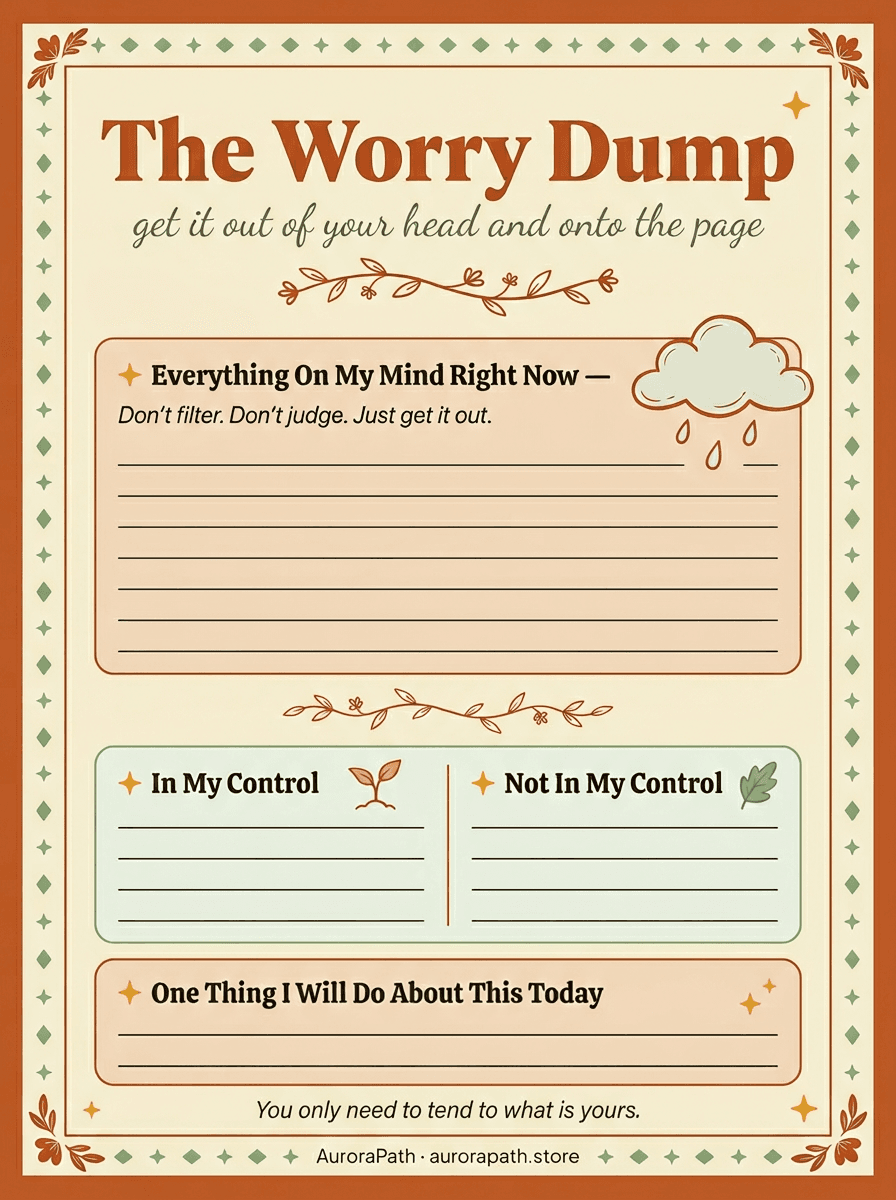
2. Externalise on paper. Rumination thrives in the head because working memory keeps the material vague and swirling. Writing forces sequence and concreteness — and the vagueness is the fuel. Two formats work: the unstructured dump (everything, ten minutes, no editing) or, better for repeat offenders, two columns — what I can affect / what I can't — with one next action written under the first column. The loop quiets because its job (don't lose this! keep processing this!) has visibly been done. The research on why writing changes emotional processing is some of the most solid in this whole field.
3. Schedule the worry. Give rumination an appointment: fifteen minutes, same time daily, ideally not within two hours of bed. When laps start outside the window: "Noted. 5:30." At 5:30, sit down and genuinely think about it — you'll find it often takes four minutes and runs dry. This works because the mind's insistence is largely about not losing the concern; a reliable appointment satisfies the file-clerk without giving it the whole day. It also builds the meta-skill: thoughts are schedulable, which means they're not emergencies.
4. Shift the body to shift the mind. Rumination is a low-arousal, stuck state — and it's remarkably posture-dependent. A brisk ten-minute walk, twenty squats, a cold-water face splash, or two physiological sighs interrupt the loop physiologically rather than argumentatively. Movement is particularly effective because it occupies exactly the attentional bandwidth rumination requires while completing the stress-activation cycle the loop keeps re-triggering.
5. The sensory drop. When you can't walk or write — mid-meeting, school run — drop attention hard into one sense for sixty seconds: every sound in the room, or the full physical detail of your hands. Not because the present moment is mystical, but because attention is finite and the loop can't run without it.
The 2am Loop, Specifically
Night rumination deserves its own paragraph because the deck is stacked: tired prefrontal cortex, zero distractions, and a brain that helpfully files everything unresolved under urgent. Three rules. Keep paper by the bed — one-line capture, "handle Tuesday," lights off; the loop mostly wants to be sure nothing is lost. Don't problem-solve horizontally — you have the anxiety of the problem without the faculties to solve it; everything looks worse lying down at 2am, and the morning version of you is genuinely smarter. If you're still looping after twenty minutes, get up — low light, boring activity, return when sleepy. (The full wind-down architecture is in our guide to mindfulness for better sleep.)
When the Loop Is Bigger Than These Tools
Everyone ruminates. But if the loops dominate most days, circle the same dark material for months, or come welded to persistent low mood or anxiety — that pattern is a core feature of both anxiety disorders and depression, and it responds well to actual treatment (CBT in particular targets rumination directly). The practices here will still help; they just shouldn't have to carry it alone. A GP conversation is the right next lap to take.
author: "AuroraPath"
Practices 1, 2 and 3 — noticing, writing, and structured reflection — are the daily spine of Find Your Ground, AuroraPath's 30-day mindfulness journal for adults. If your head runs laps, it was built for you. Our free collection of 10 mindfulness worksheets is an instant download at aurorapath.store.
From the AuroraPath Store
Find Your Ground
A 30-day mindfulness challenge. 90 beautifully designed pages — instant download.
$19.99
Get Find Your Ground →Instant PDF download · Print at home
AuroraPath
Creator of AuroraPath
Alex Ewing created AuroraPath to make premium mindfulness resources accessible for every family. Grow Calm is the first book in the AuroraPath collection.