
There is a particular kind of overwhelm that is very hard to describe to someone who has not experienced it.
It is not one big thing. It is the accumulation of everything — the work demands and the relationship tensions and the financial worries and the health anxieties and the background noise of the news and the specific private weight of the things you have not dealt with yet and may never deal with. It is all of it at once, unranked and unprocessed, pressing on the nervous system simultaneously.
When people in this state are advised to practise mindfulness the advice can feel almost insulting. Sit and breathe? That is your solution?
I understand that reaction. And I want to offer something more honest and more useful than the sanitised version of mindfulness that gets presented as a universal remedy.
What Stress and Overwhelm Actually Are
Stress and overwhelm are different experiences that often occur together.
Stress is the response to a perceived demand that exceeds perceived resources. The key word is perceived — the brain is making a rapid assessment of what is being asked of you and what you have available to meet that demand. When the assessment comes back as deficit — more demanded than available — the stress response activates.
Overwhelm is what happens when there are too many inputs for the processing system to handle — too many demands, too many decisions, too many unresolved items, too much sensory or emotional information arriving simultaneously. The system does not crash exactly. It freezes, fragments, or flails.
Both states are physiological as much as psychological. The stress response — cortisol, adrenaline, elevated heart rate, sharpened threat detection — evolved for acute physical danger. It is extraordinarily effective for running from predators and extremely counterproductive for managing an overflowing inbox or a difficult family situation.
Mindfulness intervenes at the physiological level. It does not solve the problems causing the stress. But it directly modulates the nervous system's response to those problems — which changes what resources you have available to address them.
The Honest Truth About Mindfulness and Overwhelm
When you are genuinely overwhelmed mindfulness is hard. Your attention scatters. Sitting still feels impossible. The idea of observing your thoughts non-judgementally when your thoughts are a chaotic hurricane of unfinished items and unresolved worries requires a level of mental space you do not currently have.
This is normal. It is not evidence that mindfulness does not work for you.
What it means is that you need a different entry point than formal seated meditation. Overwhelming states require techniques that are more active, more grounding, and more immediately regulating than watching your breath.
What Actually Works When You Are Overwhelmed
Physical regulation first. When overwhelm is acute the nervous system needs to be physically regulated before the mind can access any of the more cognitive mindfulness approaches. This means movement — even brief, even minimal. A short walk. Shaking your hands and arms for thirty seconds. Stretching. Splashing cold water on your face or running it over your wrists.
These physical interventions work because the stress response is a physical state. You cannot think your way out of a physiological activation. You have to move through it — literally.
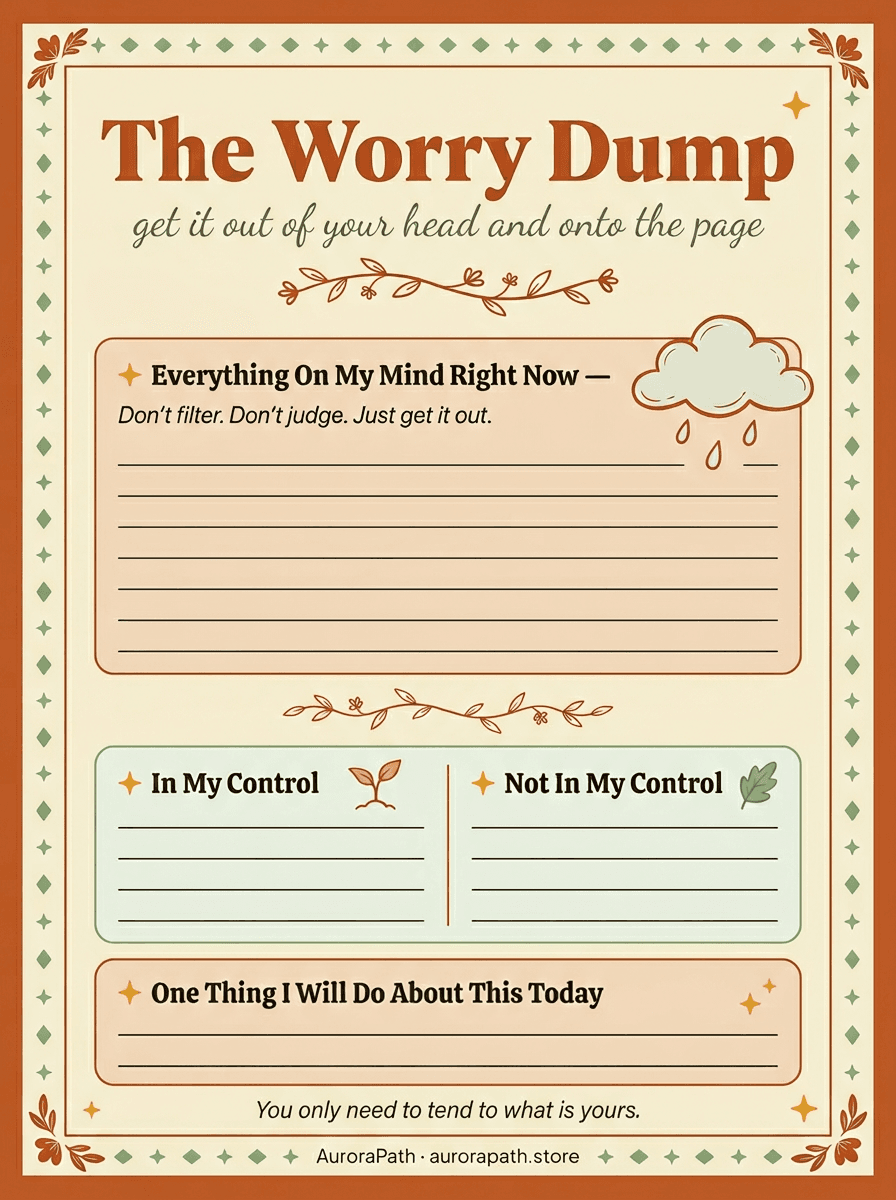
The container technique. When your mind is full of everything at once — when there are too many unresolved items simultaneously demanding attention — write them down. All of them. Everything that is taking up mental space. In no particular order, in no particular format. Just get it out of your head and onto paper.
This is not organisation. It is offloading. The brain uses a significant amount of cognitive resource simply maintaining awareness of unfinished things — a phenomenon psychologists call the Zeigarnik effect. When those things are written down the brain can partially release its grip on them because they are no longer at risk of being forgotten. The act of writing them down literally frees up cognitive and emotional resource.
Once everything is out of your head and on paper — you do not have to do anything with the list immediately. The relief often comes from the offloading itself.
The single next action. When overwhelm is paralysing — when there is so much to do that you cannot start anything — identify one single next action. Not a project. Not a goal. One concrete physical action you could take in the next ten minutes.
Not sort out my finances — but open my banking app and look at the balance. Not deal with the difficult conversation — but send a message saying I would like to talk. Not get on top of work — but open my email and read the most recent message.
The overwhelmed brain struggles with abstraction. It needs something concrete and immediate and achievable. One next action provides that. Completing it, however small, begins to restore a sense of agency — which is the direct antidote to the helplessness that overwhelm produces.
Mindful noticing in short bursts. When the mind is too scattered for a sustained practice — practise in micro-moments instead. One conscious breath before you open a difficult email. Thirty seconds of feeling your feet on the floor before a challenging conversation. Noticing the sensation of your hands around a warm cup before you start a difficult task.
These micro-moments of presence do not solve overwhelm. But they interrupt the automatic pilot — the state in which everything happens reactively and nothing is consciously chosen — and create brief windows of genuine agency within a difficult day.
Over time, practised consistently, these micro-moments accumulate into something that feels like a different relationship with stress — not the absence of it but a greater capacity to meet it without being entirely controlled by it.
The Practices Worth Building for the Long Term
The practices described above are crisis interventions — useful in acute moments of stress and overwhelm.
For the long term what reduces stress and overwhelm is building a nervous system that is more resilient — that returns to baseline more quickly after activation, that has a lower baseline threat response in ordinary conditions.
This is built through consistent regular practice over months — not crisis management. Ten minutes of intentional presence daily. A journaling practice that processes rather than suppresses. Regular physical activity. Adequate sleep. Boundaries around the inputs that are filling your system.
None of this is glamorous. None of it is quick. But the research on stress and resilience is unambiguous — these practices work, they compound over time, and the investment made in them during relatively stable periods pays dividends during the genuinely hard ones.
You are building something. It takes time. Be patient with yourself.
Related reading: stress vs burnout and micro-breaks at work.
If you want the daily-practice structure this article describes without having to design it yourself, Find Your Ground — AuroraPath's 30-day mindfulness journal for adults — builds it for you, ten minutes at a time. Our free collection of 10 mindfulness worksheets, including stress management tools, is also available as an instant free download at aurorapath.store.
From the AuroraPath Store
Find Your Ground
A 30-day mindfulness challenge. 90 beautifully designed pages — instant download.
$19.99
Get Find Your Ground →Instant PDF download · Print at home
AuroraPath
Creator of AuroraPath
Alex Ewing created AuroraPath to make premium mindfulness resources accessible for every family. Grow Calm is the first book in the AuroraPath collection.