You are exhausted, irritable, and the things that used to feel manageable don't anymore. Friends say you're "stressed." A voice in the back of your head wonders if it's something more.
It matters which one it is — because stress and burnout are not the same thing, and the things that fix one can completely fail to touch the other. A weekend away can genuinely reset a stressed nervous system. For burnout, it barely registers.
Here is the difference, how to tell which side of the line you're on, and what to do first in each case.
The Core Difference: Too Much vs Nothing Left
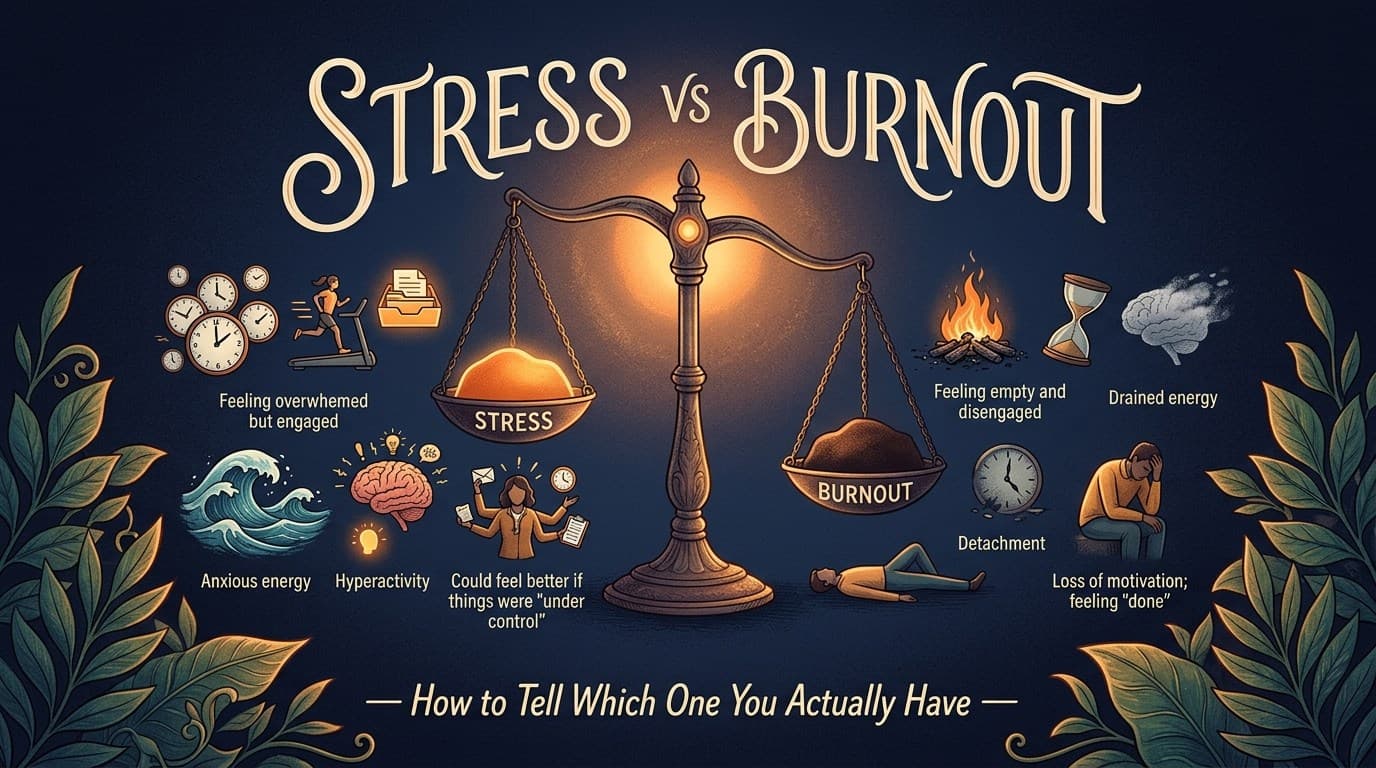
Stress is a state of too much. Too many demands, too many inputs, too much urgency. A stressed person is still engaged — over-engaged, usually. They care intensely about the things piling up. The system is running hot.
Burnout is a state of nothing left. Where stress is over-engagement, burnout is the collapse that follows long after the engagement stopped being sustainable. A burnt-out person doesn't feel urgency anymore — they feel flat. The system isn't running hot. It has shut sections of itself down to survive.
This is why the classic advice mismatch happens. Rest genuinely treats stress, because a stressed system still knows how to recover — it just needs the demands to pause. Burnout doesn't respond to a week off, because the problem is no longer the demands. It's what months or years of unmet demands did to your capacity, your sense of meaning, and your relationship with the work itself.
The Three Dimensions of Burnout
Burnout research — built on decades of work by psychologist Christina Maslach — consistently describes three distinct dimensions. Stress shares the first one. Burnout has all three.
1. Exhaustion. Not tiredness that sleep fixes — depletion that survives the weekend. You wake up tired. Small tasks feel like large ones. Your recovery systems seem to have stopped working.
2. Cynicism and distancing. This is the dimension people miss. Burnout creates emotional distance from the work and the people in it — a creeping detachment that can look like sarcasm, numbness, or simply not caring about things you used to care about deeply. It is a protective mechanism: the system reduces emotional investment because investment costs energy it doesn't have.
3. A collapsed sense of effectiveness. The growing conviction that nothing you do matters or works — that you're bad at this now, that your effort produces nothing. Often this isn't supported by the evidence. It's a symptom, not an assessment.
Stress, by contrast, usually leaves caring intact. A stressed person is anxious because they care. When the caring itself starts to go — when you notice numbness where worry used to be — that is the signature of the line being crossed.
An Honest Self-Check
Sit with these for a moment. Not how you'd like to answer — how it actually is.
- Does a genuinely restful weekend restore you, even partly? (Stress: usually yes. Burnout: barely or not at all.)
- Do you still care about the outcome of your work, even if it overwhelms you? (Stress: yes, intensely. Burnout: less and less.)
- When you think about the source of pressure, do you feel activation — racing thoughts, urgency? Or flatness and dread?
- Have people close to you commented that you seem "checked out" rather than wound up?
- Do you catch yourself being cynical about things that used to matter to you?
- Has your sense of being good at what you do quietly eroded over months?
More activation, urgency, and intact caring points to stress. More flatness, detachment, and erosion points toward burnout. Most people in the burnout zone will recognise the moment the caring changed — even if they can't date it.
What to Do First If It's Stress
Stress responds to load management and recovery, and it responds fairly quickly.
Reduce inputs before adding practices. The instinct is to add things — meditation, exercise, supplements. Subtraction works faster. What can come off the plate this week, even temporarily?
Restore the basics. Sleep, movement, and real breaks do more for a stressed system than any technique. The research on micro-breaks and recovery is unambiguous: short, regular disengagement protects you.
Add a daily down-regulation practice. Ten minutes of breathwork or mindfulness daily measurably lowers baseline arousal over weeks. Our guide to mindfulness for stress and overwhelm covers what genuinely helps.
Done consistently, stressed systems usually feel different within two to four weeks.
What to Do First If It's Burnout
Burnout recovery is slower and more structural, and pretending otherwise is how people relapse.
Stop expecting rest alone to fix it. Rest is necessary but not sufficient. The exhaustion dimension responds to rest; the cynicism and effectiveness dimensions respond to change — in load, in boundaries, in how the work relates to what you value.
Triage ruthlessly. Not everything on your plate is equally load-bearing. Identify the two or three demands doing the most damage and change your relationship with those specifically — renegotiate, reduce, or in some cases leave. Generic "self-care" spread thinly across an unchanged life does almost nothing.
Rebuild capacity in small, repeated doses. This is where a structured daily practice earns its place — not as a cure, but as the scaffolding recovery happens inside. Regulating the nervous system daily, reconnecting with what you actually feel and value, building habits that hold. (That arc — soften, reconnect, expand — is exactly the structure of Find Your Ground, our 30-day mindfulness journal for adults, and burnout recovery is the situation it was designed around.)
Get real support if the flatness is deep. Burnout overlaps with depression, and the line between them is genuinely hard to self-assess. If the numbness extends well beyond work, if nothing brings any pleasure, or if you're having thoughts of hopelessness — speak to your GP. That isn't an admission of failure. It's accurate triage, which is the skill this whole article is about.
The Timeline Question
People want to know how long recovery takes. The honest answer: stress, weeks; burnout, months. Burnout took a long time to build and it unwinds on a similar scale — most people notice real change somewhere between three and six months of genuinely different conditions, not three to six weeks.
That number discourages people. It shouldn't. It just means the work is structural rather than cosmetic — and structural change is the kind that lasts.
author: "AuroraPath"
If you recognised yourself in the burnout column, Find Your Ground — AuroraPath's 30-day mindfulness journal for adults — was built for exactly this: fifteen minutes a day of nervous-system regulation, honest reflection, and slow rebuilding. Our free collection of 10 mindfulness worksheets is also available as an instant free download at aurorapath.store.
From the AuroraPath Store
Find Your Ground
A 30-day mindfulness challenge. 90 beautifully designed pages — instant download.
$19.99
Get Find Your Ground →Instant PDF download · Print at home
AuroraPath
Creator of AuroraPath
Alex Ewing created AuroraPath to make premium mindfulness resources accessible for every family. Grow Calm is the first book in the AuroraPath collection.