
It's 8:47pm. Teeth are brushed, the story is read, the landing light is negotiated — and then it comes, in that small voice from the pillow: "I can't stop thinking about…" The test. The friend thing. The dog that barked. Whether you'll die one day. The thoughts that waited politely all day and chose now.
Children's worries don't pick bedtime to be difficult. They pick bedtime because of how attention works — and once you see the mechanism, the fixes follow naturally.
Why Worries Get Loud at Night
During the day, a child's attention is fully booked: school, friends, screens, snacks, the next thing. Worries queue in the background, mostly unattended. Bedtime is the first moment the queue gets served — the room is dark, the stimulation is gone, and there is nothing else for attention to do. Add a tired brain (which regulates emotion poorly) and stillness (which makes body sensations of anxiety more noticeable), and you have the perfect amplifier.
This reframe matters for parents: the bedtime worry flood is not manipulation or stalling — well, not usually — and it's not a new problem appearing at night. It's the day's unprocessed residue meeting its first quiet moment. Which means the solution isn't better arguments at 8:47pm. It's giving the residue somewhere to go earlier, and giving the child tools for the quiet.
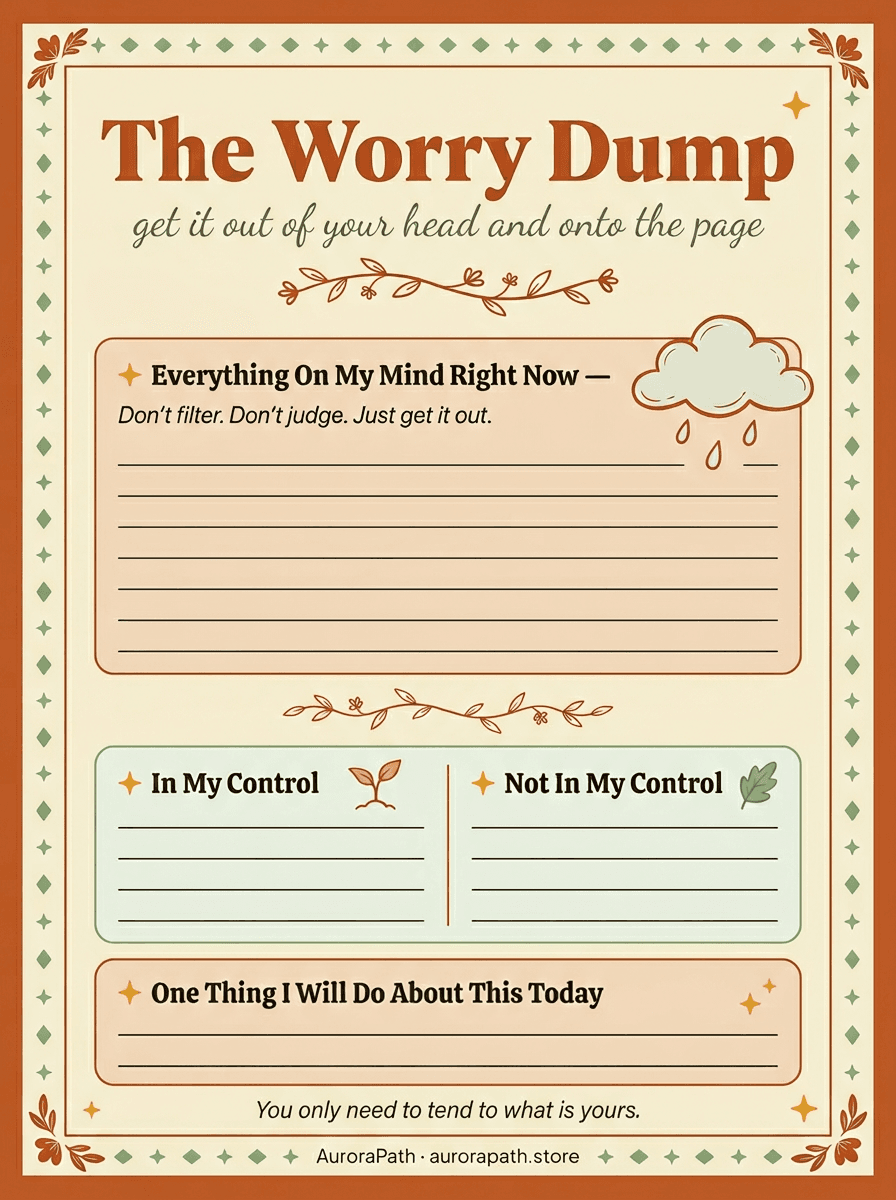
The Worry Dump — the Core Ritual
Thirty to forty-five minutes before lights out — not in bed, somewhere ordinary like the kitchen table — run a five-minute worry dump:
- Ask for the list. "Let's empty the worry pockets before bed. What's in there tonight?" Everything counts: big, small, weird.
- Write each one down — you scribe for younger children; older ones can write or draw. The physical act matters: a worry on paper is demonstrably out of the head and held somewhere.
- Sort, lightly. Two piles: "things we can do something about" and "things that just need to be felt." For pile one, write a single tiny next step ("ask Miss Patel about the test"). For pile two, just say so, kindly: "That one's a feeling one. Feelings pass through."
- Close the container. Fold the paper into a box, a jar, or under a designated stone. Say the line: "The worries stay out here tonight. They're my job until morning."
Children are intensely literal, which is why the ritual works better for them than for adults: the worries are visibly elsewhere, and a trusted adult has visibly taken the shift. Expect the first nights to produce long lists; they shorten dramatically within a week or two as the system learns the worries reliably get heard.
This is the child-sized version of the same externalisation that works in adult overthinking — the mind holds on loudly until it's sure nothing will be lost.
In-Bed Tools for the Quiet
Even with a good dump, some nights the brain restarts. Tools for the pillow:
The body-anchor. "Press your back into the mattress. Feel how the bed pushes back? It's holding you all night without trying." Attention on physical contact points gives the mind a quiet job that isn't worrying — the bedtime cousin of grounding.
Hot chocolate breathing, lying down. Slow smell-the-cocoa inhale, longer cool-it-down exhale, five rounds. The long exhale is doing real physiological work — slowing the heart and signalling safety. (All five kid-friendly patterns are in our breathing exercises guide.)
The boring story. Tell yourself the day backwards in tiny boring detail, starting from now: got into bed, brushed teeth, put the cup in the sink… Most children are asleep before lunch. It works by occupying the narrative mind with material too dull to fear.
The worry parking ticket. Keep three paper slips and a pencil by the bed. A worry that arrives after lights-out gets one line on a slip — then it's parked till morning, same contract as the dump. Three slips is the limit; brains respect rationing more than bans.
What to Say (and Not Say)
The instinct at 8:47 is logic: that won't happen, you'll be fine, there's nothing there. Anxious brains don't take logic at night — but they do take validation plus containment:
- Instead of "There's nothing to worry about" → "That worry feels big in the dark. Worries always look bigger at night — it's a trick they do."
- Instead of "Go to sleep, we'll talk tomorrow" → "Tell me in one sentence, I'll write it on a slip, and it becomes my job till breakfast."
- Instead of "You were fine last night!" → "Some nights are wobbly ones. Your bed's got you, and so have I."
(The full phrasebook — and why validation has to come before any plan — is in what to say when your child is anxious.)
One structural note: keep the connection generous and the duration boundaried. Two minutes of full-presence worry-hearing beats twenty minutes of negotiation that teaches bedtime is extendable by anxiety. Warmth on the feelings, firmness on the clock.
When Night Worry Is Signal, Not Noise
Most bedtime worry responds well to two or three weeks of dump-plus-tools. Take a closer look if: the worry is fixated on one specific recurring theme (school dread, a particular person, family safety after a loss), it comes with frequent nightmares or refusal to sleep alone where that's new, it's costing real sleep most nights for over a month, or daytime anxiety is climbing alongside. Start with a gentle daytime conversation and the school's view; bring in your GP if the picture doesn't ease. Persistent sleep-disrupting anxiety is very treatable — and the earlier it's met, the smaller it stays.
author: "AuroraPath"
A calm, predictable wind-down makes every tool above work better — our guide to a mindful bedtime routine is the companion piece. And Grow Calm, our 30-day printable mindfulness book for ages 7–11, builds the worry-taming toolkit one illustrated day at a time. Free worksheets at aurorapath.store.
From the AuroraPath Store
Grow Calm
A 30-day mindfulness challenge for kids aged 7–11. 96 beautifully illustrated pages — instant download.
$15.99
Get Grow Calm →Instant PDF download · Print at home
AuroraPath
Creator of AuroraPath
Alex Ewing created AuroraPath to make premium mindfulness resources accessible for every family. Grow Calm is the first book in the AuroraPath collection.