How to help your child manage anxiety

Your child tells you they're worried about the spelling test next Friday. You say, "You'll be fine—you always do well." Their shoulders tense. They ask…

A

AuroraPath

June 21, 2026

Cover illustration for How to help your child manage anxiety

Free Download

Enjoying this article? These 10 free worksheets go even deeper. 🌱

Claim your free AuroraPath mindfulness worksheet collection instantly.

Instant download · No credit card needed

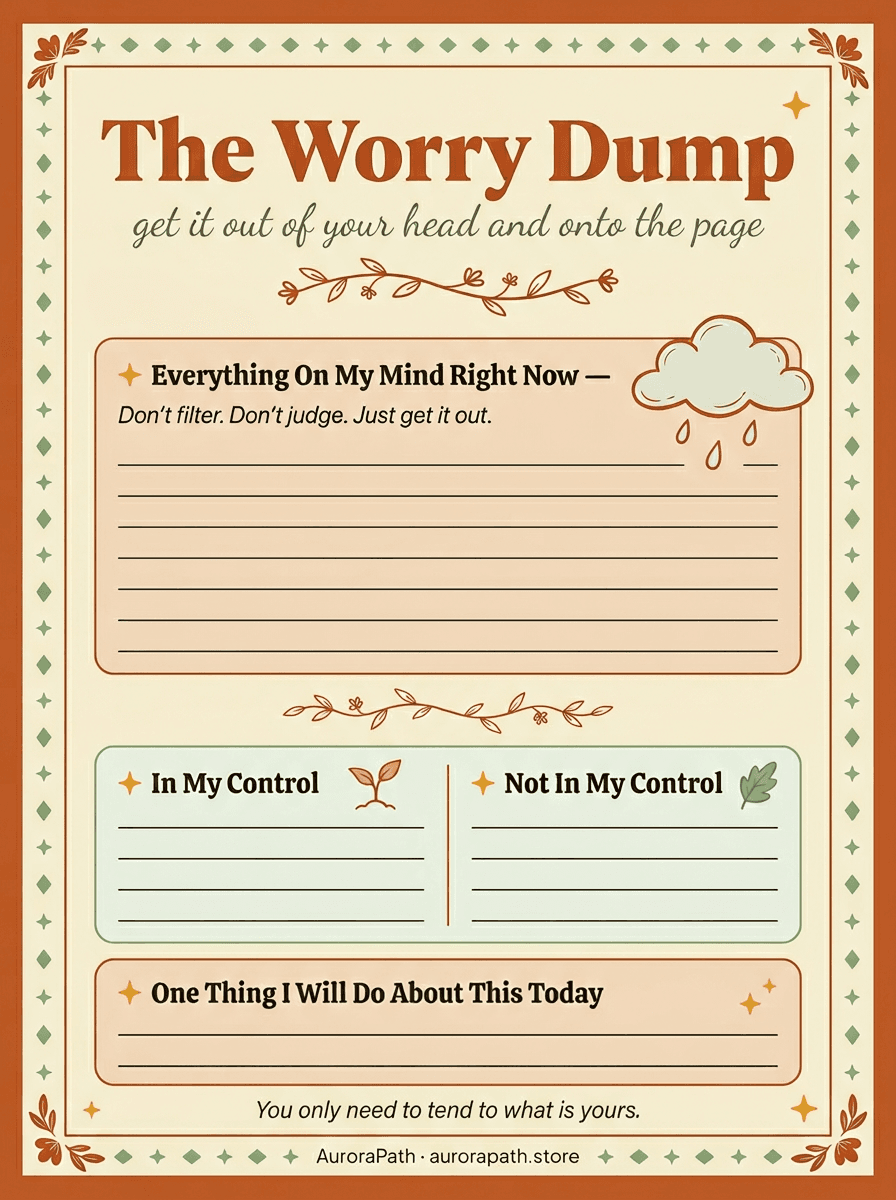
Sample worksheet preview

+ 9 more worksheets

The Anxiety Loop: Why Reassurance Backfires (and What Works Instead)

Your child tells you they're worried about the spelling test next Friday. You say, "You'll be fine—you always do well." Their shoulders tense. They ask again: "But what if I mess up?" You reassure them again. By bedtime, they're catastrophizing about failing the entire grade.

This is the reassurance trap, and it works the opposite of how you'd expect.

When you tell an anxious child "Don't worry, it won't happen," you accidentally confirm that the worry is real and scary enough to need reassurance. Their brain hears: This is a genuine threat that requires adult intervention. The reassurance feels good for about ninety seconds. Then the anxiety comes back, often stronger, because the child learned that worry = something to fight, not something to notice and move through.

The research is clear: reassurance actually feeds the anxiety loop. Each time you step in to calm the worry, the child's nervous system doesn't learn to regulate itself. Instead, it learns that anxiety is an emergency requiring rescue.

Here's what works instead: shift from reassurance to noticing.

When your child says "What if I mess up the test?", you pause and say something like: "Your body is sending you a worried signal right now. That's okay—let's just notice it together for a moment." Then you sit with them and do a quick five-senses anchor: name three things you both see, two things you hear, one thing you feel in your body right now. Sixty seconds. No "it'll be fine" attached.

What you're teaching is this: Worry is a signal, not a threat. Your child learns to observe the anxiety—to step off the tracks and let the train pass—rather than fight it or need you to fight it for them. That shift from victim-of-anxiety to observer-of-anxiety is where agency lives.

The difference is measurable. A child who's been reassured spirals. A child who's learned to notice their own body's signals can interrupt the loop themselves, even at age six or seven. They don't need you in the room every time; they've internalized the practice.

This doesn't mean you never reassure your child. It means you pair reassurance with a concrete tool—a ritual they can return to when the worry comes back, which it will. That's the real work: teaching them they can handle it.

How Mindfulness Interrupts the "What-If" Spiral

Your anxious child's brain is a prediction machine running in overdrive. It's not broken—it's just stuck in a loop, fast-forwarding to worst-case scenarios and rehearsing them until they feel real. A child worried about tomorrow's soccer game doesn't just think about the game once; they run it forward fifty times, each time adding a new "what if": What if I miss the ball? What if the other kids laugh? What if I freeze? Each rehearsal tightens the knot in their stomach.

Mindfulness doesn't stop the prediction machine. It pulls your child out of the loop—temporarily, but that's enough.

Here's how it works. When your child is anchored to what's happening right now—the feel of the grass under their feet, the sound of the wind, the taste of water—their nervous system gets a signal: "The threat is not actually happening." The worry is real, but the danger is not. That distinction is everything. A child stuck in the what-if spiral is living in the future; a child noticing their five senses is living in the present, where they are safe.

A worked example: Your 8-year-old has a doctor's visit tomorrow and has spiraled into catastrophe-thinking since dinner. Bedtime is coming and they won't settle. Instead of more reassurance (which often feeds the spiral), you sit with them and say: "Let's notice what's real right now." You both spend 90 seconds listing what you see, hear, and feel in that moment—the lamplight, the sound of the house settling, the blanket soft on their skin. You're not trying to make the worry vanish. You're giving their nervous system evidence that this moment is safe. Then you name it: "The doctor's visit is tomorrow. Right now, you're in bed, and you're okay."

That one reset doesn't erase tomorrow's anxiety, but it breaks the rehearsal loop enough to let them sleep. And more importantly, it teaches them: I can notice when my mind is running away. I can bring myself back. That's the skill. That's what they'll use next time the what-ifs start.

The five-senses anchor works because it's concrete and fast—no meditation posture, no "clear your mind" instruction that makes a spiraling child feel more broken. It's also portable: you can do it in a car, at the kitchen table, or in the waiting room before the appointment itself.

📥 Claim Your Free 10

Get 10 free mindfulness practice pages — no email gymnastics, just the download. [ Claim the Free 10 → ]

The Five-Senses Anchor: Your Fastest Entry Point

Here's how it works: anxiety lives in the future. Your child's brain is running a loop of "what-ifs"—what if I mess up the test, what if the doctor finds something wrong, what if everyone laughs at me—and each replay tightens the nervous system a little more. Mindfulness interrupts that loop by yanking attention back to right now, where none of those things are happening.

The five-senses anchor does this in under two minutes because it's concrete and impossible to argue with. You're not asking your child to "clear their mind" or sit still in silence—both feel like punishment to an anxious kid. You're asking them to notice.

Here's the mechanism: when your child names what they actually see (the kitchen table, a crack in the ceiling, your face), hear (the hum of the fridge, a car outside, their own breath), and feel (the chair under their legs, the fabric of their shirt, the floor under their feet), their brain has to drop out of the future-loop and land in the present. That's not a metaphor—it's a neurological shift. The prefrontal cortex (the thinking brain) re-engages, and the amygdala (the alarm system) gets a signal that there is no active threat.

A worked example: Your 8-year-old is spiraling the night before a soccer game. "What if I'm terrible? What if I miss the goal? Everyone will think I'm bad." You sit beside them and say: "Let's notice five things right now." You go first: "I see your blue blanket. I hear the clock ticking. I feel the bed under me." Then they try. They might say: "I see your sleeve. I hear... um... the wind? I feel my pillow." That's it. Thirty seconds in, their voice has already dropped an octave. Their shoulders are lower. The train hasn't disappeared, but they've stepped off it.

The magic is that you do it with them. Your calm nervous system is contagious—neuroscience calls this co-regulation. When your child sees you doing the same thing, not rushing them, not trying to fix their worry, they learn: "This is something I can do when I'm scared." That's not a coping skill; that's agency.

Smell amplifies this. A few drops of lavender on a tissue, or a familiar plant they touch while they breathe—these create a sensory anchor they can return to on their own later.

Why Your Calm Matters More Than Your Child's Practice

Your nervous system is a tuning fork. When you're steady, your child's body reads that signal and begins to settle—even if their mind is still spinning with worry. This is not metaphor; it's neurology. A child's brain is still building its own regulation circuits, so it borrows yours.

Here's the mechanism: when your child feels anxious, their amygdala (the alarm center) is firing. If you respond with urgency, reassurance-overdrive, or your own visible tension, you've just confirmed to their nervous system that the threat is real and serious. The alarm stays on. But if you stay grounded—breathing normally, speaking in an even tone, moving slowly—your child's mirror neurons and vagal pathways sync to your state. Their heartbeat can actually slow to match yours.

This doesn't mean you perform fake calm or suppress your own feelings. It means you do your own five-senses anchor first, or take three deliberate breaths while your child is upset, so you're regulated enough to be present with them.

Here's a worked example. Your eight-year-old wakes at midnight, spiraling about a presentation due in two weeks. Your instinct is to say, "You'll do great, don't worry." Instead, pause. Notice your own breath for five seconds—feel your feet on the floor, hear the quiet house. Now sit with them. Say: "I see you're worried. I'm here, and I'm calm. Let's do something together." Guide them through a slow five-senses check: "Name one thing you see right now. One thing you hear. One thing you feel." No rushing. Your steady presence is doing the heavy lifting.

The presentation is still two weeks away. Their anxiety isn't solved. But their nervous system has learned: "When I'm scared, my parent can stay steady. That means I'm safe enough to slow down." Over time, that becomes: "I can slow myself down."

The paradox: the less you try to fix their anxiety, the faster they learn to regulate it. Your job is not to make worry vanish. Your job is to stay anchored so they can borrow your groundedness until they build their own.

This is why a two-minute ritual you do together outperforms a ten-minute app they use alone.

Scent as a Nervous-System Reset: The Underrated Tool

Smell bypasses the thinking brain and lands straight in the limbic system—the emotional switchboard. When your child inhales a familiar scent, the signal travels directly to the amygdala and hippocampus, the same structures that fire during anxiety, and it can shift the nervous system's state in under 30 seconds.

This is why a visual calm-down poster or a breathing app often fails when your child is already spiraling. By the time their prefrontal cortex (the reasoning part) is available to follow an instruction, the amygdala has already locked in. Scent works because it doesn't ask permission—it just resets.

Here's a worked example. Your 8-year-old wakes at 2 a.m. with a stomach knot about the school presentation tomorrow. Their mind is already three steps ahead: What if I forget my words? What if the class laughs? The anxiety loop is live.

You sit on the edge of the bed with a small lavender roller (or a tissue with two drops of lavender oil, or even a sprig of mint from the kitchen). You roll it gently on their wrist or have them smell it for three slow breaths while you breathe alongside them. You say nothing about the presentation yet.

What happens neurologically: the scent signal reaches the amygdala and triggers a subtle downregulation—not sedation, but a shift from threat-detection mode to baseline. Their shoulders drop a notch. Their breathing slows because yours is slow. Now their prefrontal cortex is back online.

Only then do you say: "Your body is telling you it's worried about tomorrow. That's normal. Let's think about one thing you know how to do really well in that presentation." You've moved from "shut down the anxiety" to "notice it, then problem-solve," and the scent was the bridge.

The scent itself becomes the signal. After three or four repetitions, your child's nervous system learns: When I smell lavender + slow breathing, the threat-alert can pause. You've anchored a reset to something concrete and portable—no app needed, no quiet room required, works in the car, works at school if you've sent a small roller in their backpack.

Pair this with the five-senses grounding from earlier, and you have a two-tool sequence: scent to reset the nervous system, then senses to anchor attention to the present moment where the worry isn't actually happening.

Three High-ROI Moments to Teach the Practice (Bedtime, Pre-Event, the Walk)

The timing of a mindfulness practice matters more than its length. You are not building a daily meditation habit—you are teaching your child a tool they can reach for when anxiety is already present and they are already motivated to feel better.

Bedtime spirals. A child lying awake at 9 p.m., mind looping through tomorrow's math test or a social worry, is primed to learn. Sit on the edge of the bed and invite them to notice five things they can see in the dark room—the glow of the nightlight, the shadow of the bookshelf, the texture of the blanket. Then four things they can feel: the pillow under their head, the weight of the covers, the air on their face, their feet under the sheet. Three things they can hear: the hum of the house, traffic outside, their own breath.

This is not relaxation training. It is attention training. Each time you name a sensation, you are pulling their mind from "what if I fail the test" into "I feel the pillow." The anxiety does not vanish—but the mental loop pauses. After two minutes, most children are calmer. More importantly, they learn: When my mind gets stuck in worry, I can unstick it by noticing what is real right now.

Pre-event anxiety. The night before a doctor's visit, a school performance, or a sleepover, introduce the same five-senses anchor—but add a scent. Light a lavender candle or uncap a lavender roller and let them smell it while you both breathe. The smell becomes the signal: "This is our calm-down smell." Next time they are anxious, the scent alone will begin to settle their nervous system because their body has learned the association.

A worked example: your 8-year-old is afraid of the dentist and has been worrying for three days. The night before, sit together for two minutes. Smell the lavender. Notice five things you see, four you hear, three you feel. Say: "Tomorrow, when we're in the waiting room and you feel nervous, we can smell this again and remember what we just did." You are not promising the dentist won't be scary. You are giving them a concrete action they control.

The walk. A 10-minute walk around the block with no screens is a disguised mindfulness practice. Play "I spy" with your senses: "I see three things—that red car, the tree, the mailbox. You find three." Listen together for sounds. Feel the breeze or the sun. This is connection, not a chore, and it teaches the same skill: attention to the present moment, where your child is safe.

When Mindfulness Is Enough—and When It Isn't

Here is the honest line: mindfulness is a powerful tool for the anxiety cycle, but it is not a cure, and it is not a substitute. A child who practices five-senses grounding before a doctor's visit will likely feel calmer in that moment. But a child whose anxiety is so severe that she refuses school, or whose sleep is shattered by nighttime spirals three nights a week, needs more than a breathing exercise.

The distinction matters because parents often carry guilt about this. You may feel that if you just teach your child the right technique, anxiety will soften. It won't always. And that is not a failure on your part.

Here is what mindfulness reliably does: it interrupts the forward-projection loop—the "what-if" machine that runs in an anxious child's mind. When your child notices her breath, or names five things she can see right now, she is anchoring to the present moment, where the threat is not actually happening. Studies show measurable reductions in anxiety symptoms and improved focus in children who practice regularly. For mild to moderate anticipatory anxiety—worry about a specific event that hasn't occurred yet—this is often enough.

Here is what it does not do: it does not rewire a child whose anxiety is woven into her nervous system so tightly that she cannot access the present moment at all. It does not resolve trauma. It does not replace sleep or nutrition or safety. And it does not treat clinical anxiety disorders, which require a child therapist or counselor.

A practical marker: if your child's anxiety is interfering with school attendance, friendships, or sleep more than two or three nights a week, or if mindfulness practice itself triggers resistance or a meltdown, that is a signal to bring in a professional. A therapist trained in cognitive-behavioral therapy (CBT) or trauma-informed care can work alongside mindfulness, not instead of it.

The most effective path is often both-and. Your child learns five-senses grounding from you, practices it on calm days so it feels familiar, and uses it as a first-line reset when anxiety shows up. Simultaneously, if needed, she works with a therapist who helps her understand why her nervous system is so quick to alarm. Mindfulness keeps her regulated in the moment. Therapy rewires the alarm itself.

Your role is to notice the difference, without shame. Mindfulness is a gift you can give your child. It is also not the whole answer, and that is okay.

From the AuroraPath Store

Grow Calm

A 30-day mindfulness challenge for kids aged 7–11. 96 beautifully illustrated pages — instant download.

$15.99

Get Grow Calm →

Instant PDF download · Print at home

A

AuroraPath

Creator of AuroraPath

Alex Ewing created AuroraPath to make premium mindfulness resources accessible for every family. Grow Calm is the first book in the AuroraPath collection.

helpchildmanageanxietyparents
Share:FacebookPinterest